
Tax Deductions for Contractors: 16 Best Write-Offs and the Records That Back Them Up
Do you know which tax deductions for contractors you can actually claim?
Or are you guessing and hoping for the best at tax time?
Maybe you buy tools, drive between job sites, and pay a sub or two.
And you have no clue what counts, what doesn't, or what proof you need.
Or you worry one bad receipt, or one missing log, will come back to bite you.
I get it.
You're busy running jobs, not studying the tax code.
So here's the plain-talk version.
I'll walk you through 16 tax deductions for contractors, the catches on each one, and the records that make them hold up.
Disclosure: some links in this article are affiliate links, so I may earn a commission if you sign up through them, at no extra cost to you.
If you want a second set of eyes on your numbers as you read, you can get help reviewing your business tax plan.
This article is general education, not tax advice.
What Counts as Tax Deductions for Contractors?

Here's the basic idea.
As an independent contractor, you're generally treated as self-employed.
That means your business income and expenses typically land on Schedule C, and you may owe self-employment tax on your net profit.
Your deductions reduce that net profit.
To deduct an expense, it generally has to be ordinary and necessary.
Ordinary means common in your trade.
Necessary means helpful and appropriate for your work.
A framer buying a nail gun? Easy.
The same framer buying a vacation cabin? Good luck.
One more thing trips people up.
A deduction lowers the income you're taxed on.
A credit reduces the tax bill itself.
They're different tools, so don't mix them up.
If you run your business through an LLC, the rules shift a bit based on how it's taxed, and I cover that in our guide to tax deductions for LLC owners.
Not sure how your setup affects your tax deductions for contractors? You can get help reviewing your business tax plan.
Track Income and Expenses First: The Foundation for Contractor Tax Deductions
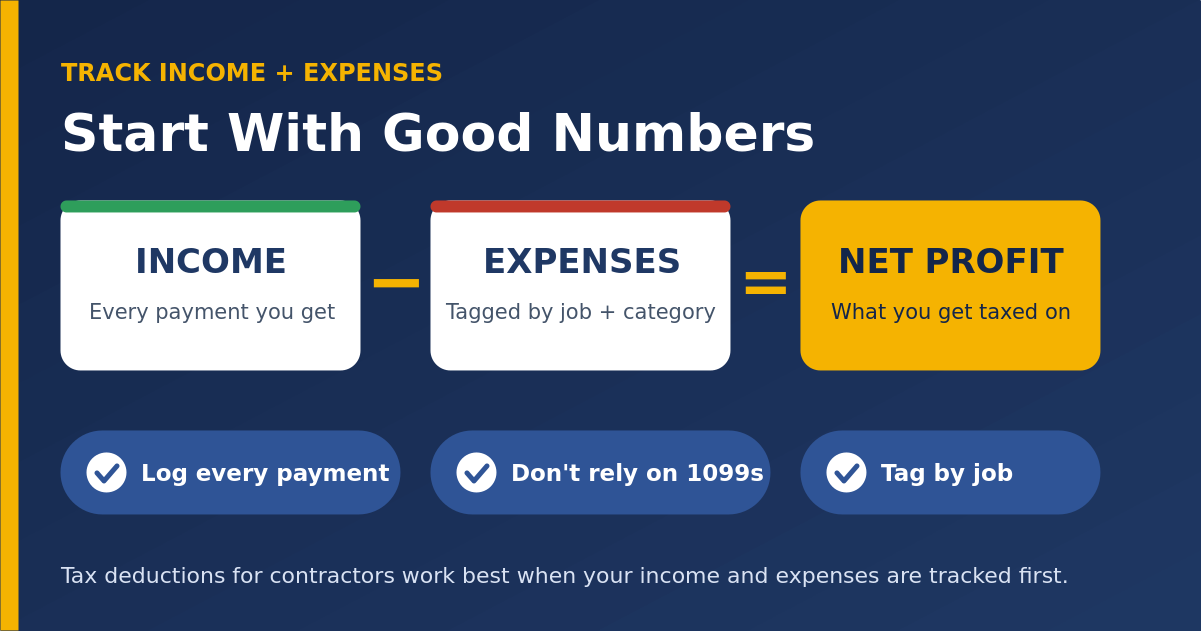
Deductions start with good numbers.
And that means tracking income, not just expenses.
Here's the simple setup:
• Log every payment you receive. Include checks, cash, apps, and transfers.
• Keep your 1099s, but don't rely on them. You generally report all your income, even if a client never sends a form.
• Tag every expense by job and category. It makes tax time much faster.
• Set aside money for taxes as you go. Many self-employed people pay estimated taxes during the year, so ask a pro what applies to you.
Picture this: Dan is a framing contractor.
He gets paid by five clients and two of them never send a 1099.
He still logs all five, because the income counts either way.
That's the habit.
Want help turning your income and expense tracking into a tax plan? You can get help reviewing your business tax plan.
16 Independent Contractor Tax Deductions Worth Knowing
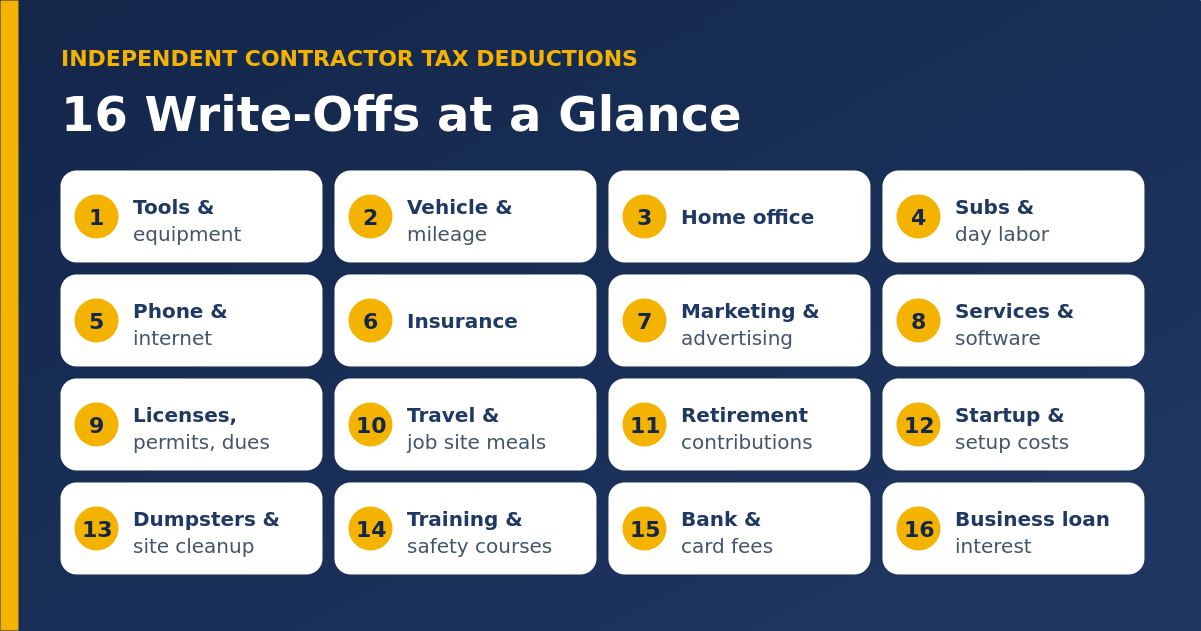
Here's the list.
For each one, I'll give you the basics and the catch.
Rules and limits below are for tax year 2026.
1. Tools, Materials, and Equipment
Small hand tools, safety gear, and daily supplies are generally deductible in the year you buy them.
For bigger purchases, the de minimis safe harbor lets you deduct items up to $2,500 per item or invoice if you don't have an audited financial statement.
It isn't automatic, so you elect it on your timely filed tax return.
Heavy equipment can go through Section 179, which has a 2026 limit of $2,560,000.
Qualified property acquired after January 19, 2025 may also qualify for 100% bonus depreciation.
Section 179 is also limited by your business income, so a pro can help you pick the right approach.
2. Vehicle Expenses and Mileage
You can generally use the standard mileage rate or your actual vehicle expenses.
The IRS set the 2026 business rate at 72.5 cents per mile.
Then it raised the rate to 76 cents per mile starting July 1.
Picture this: Dan drives 1,500 business miles in April and 1,500 more in October.
April comes to $1,087.50, and October comes to $1,140.
Same miles, different rate.
Driving between job sites can count, but your commute to a regular workplace doesn't.
Your log should show the date, destination, business purpose, and miles.
Heavier trucks and SUVs have their own depreciation rules, and some are capped at $32,000 for Section 179 in 2026.
Talk to a pro before you buy.
3. Home Office
The space has to be used regularly and exclusively for business.
You have two ways to figure it:
• Simplified method: $5 per square foot, up to 300 square feet, for a maximum of $1,500.
• Actual method: your real home expenses times the business-use percentage.
4. Subcontractors and Day Labor
Payments to subs for labor on your jobs are generally deductible.
Collect a signed Form W-9 before you pay a sub the first dollar.
You generally issue a Form 1099-NEC when you pay a sub $2,000 or more in 2026.
That threshold was $600 for payments made through 2025.
Picture this: Dan pays a sub $1,800 in 2026.
That's under the new federal threshold, so no 1099-NEC is required for that amount.
He still has the W-9, the invoices, and the payment record.
Skipping a 1099 you owed can bring penalties, and missing records make the expense harder to defend.
Some states may have different rules, so check yours.
5. Cell Phone and Internet
Deduct the business-use percentage of your bill.
A phone line used only for work is generally fully deductible.
If you use your phone 70% for work, don't deduct 100%.
6. Insurance Premiums
General liability, commercial auto, and tool or equipment coverage are generally deductible.
Health insurance premiums for you and your family may be deductible on your return, but eligibility rules apply.
7. Marketing and Advertising
Truck wraps, job site signs, flyers, website hosting, and online ads are generally deductible.
Referral fees and promotional gifts can count too.
Business gifts have limits, so check before you deduct them.
8. Professional Services and Software
Bookkeeping software, project management apps, and legal fees are generally deductible.
So are fees paid to a CPA or tax professional for your business.
9. Business Licenses, Permits, and Dues
Trade license renewals, local permits, and contractor board registrations are generally deductible.
So are dues to trade associations and local chambers of commerce.
10. Travel and Job Site Meals
Lodging, airfare, and rental cars for out-of-town jobs can be deductible.
Business meals are generally limited to 50%.
The meal needs a real business purpose, so note who was there and why.
Entertainment isn't deductible.
11. Retirement Plan Contributions
Contributions to a SEP-IRA, Solo 401(k), or SIMPLE IRA may reduce your taxable income.
Each plan has its own rules and contribution limits.
Check them before you contribute.
12. Startup Costs and Organization Fees
You may be able to deduct up to $5,000 of startup costs in your first year.
That amount shrinks dollar for dollar once startup costs pass $50,000.
The rest gets amortized over 180 months (15 years).
Legal costs to set up an entity can have a separate $5,000 limit, depending on how you're taxed.
13. Dumpsters, Sanitation, and Site Cleanup
Porta-potty rentals, roll-off dumpsters, and debris removal for your jobs are generally deductible operating expenses.
If a cost is billed to the client, track it so you don't double count it.
14. Continuing Education and Safety Training
OSHA certifications, safety training, trade seminars, and trade publications can be deductible.
Training that keeps or improves skills in your current trade generally qualifies.
Training to start a brand-new trade generally doesn't.
15. Bank and Payment Processing Fees
Card reader fees, bank service charges, and wire fees on business accounts are generally deductible.
16. Interest on Business Loans and Credit
Interest on business loans, equipment financing, and business credit cards is generally deductible.
If a card or loan is used for both personal and business spending, only the business part counts.
Want to see which of these 16 apply to you? You can get help reviewing your business tax plan.
Expenses That Don't Count as Tax Deductions for Contractors
Some costs never make the cut.
Watch out for these:
• Personal expenses: groceries, personal subscriptions, household bills
• Commuting: driving from home to a regular workplace
• Entertainment: sporting events, concerts, golf outings
• Fines and penalties: speeding tickets and late-filing penalties
• Political contributions
• Your own pay: taking money out of your business isn't an expense
Mixed-use expense?
Split it.
Deduct the business part and leave the rest.
Unsure whether something counts? You can get tax-planning support.
Records and Mileage Logs That Back Up Your Tax Write-Offs for Contractors
Knowing the rules isn't enough.
You need proof.
Without records, the IRS can disallow a deduction, and penalties may apply.
Here's the simple five-step system:
Step 1: Separate your accounts
Open a business checking account and a business card.
Mixing personal and business spending makes your deductions hard to prove.
Step 2: Collect a W-9 before the first payment
Have every sub sign one before you pay them.
It gives you what you need if a 1099-NEC is required later.
Step 3: Digitize receipts right away
Snap a photo after every purchase.
Note the business purpose and the job on the image.
Step 4: Keep a mileage log as you go
A GPS mileage app works well.
Log each trip with the date, destination, purpose, and miles.
Year-end estimates are hard to defend.
Step 5: Reconcile your books monthly
Categorize transactions at the end of each month.
You'll remember what each charge was for.
If your books feel behind, you can get help reviewing your business tax plan.
A Year-End Checklist for Contractor Tax Deductions
Year-end comes faster than you think.
Before December 31, run through this list:
• Review your books and fix miscategorized expenses.
• Reconcile your mileage log, and remember the rate changed on July 1.
• Confirm which equipment will be placed in service by December 31.
• Gather W-9s and payment records for every sub you paid this year.
• Check which subs hit the 1099-NEC threshold for 2026 payments.
• Talk to a pro before making a big purchase.
One warning.
Don't buy something just for the deduction.
A deduction lowers your taxable income.
It doesn't give you the money back.
You can get tax-planning support before year-end.
Quick Table: Tax Deductions for Contractors at a Glance
Skimming?
Here's the cheat sheet.
| Expense | Usually deductible? | Watch for |
|---|---|---|
| Hand tools and safety gear | Yes | Keep the receipt |
| Business mileage | Yes | Dated log, correct rate for the date |
| Sub payments | Yes | W-9, invoices, 1099-NEC if $2,000 or more |
| Job site meals | Yes, generally 50% | Business purpose and who attended |
| Home office | Yes, if regular and exclusive use | Simplified vs. actual method |
| Heavy equipment | Yes, via depreciation or Section 179 | Placed-in-service date |
| Commute to a regular workplace | No | Personal travel |
| Speeding ticket | No | Fines and penalties |
| Personal groceries | No | Personal expense |
Want this cheat sheet matched to your own jobs? You can get help reviewing your business tax plan.
When to Get Help With Tax Deductions for Contractors
Doing your own taxes can work when your setup is simple.
It gets harder when you have subs, equipment, vehicles, and several income streams.
A tax professional can help you check eligibility, spot missed items, and keep you compliant.
They can also talk through bigger moves, like an entity change.
If you want to go deeper, start here:
• Learn how tax planning services can fit into your year.
• Read our breakdown of small business tax planning.
• Browse more small business tax deductions you might be missing.
• If you operate as an LLC, see our guide to LLC tax deductions.
If you want a starting point for your own numbers, you can get help reviewing your business tax plan.
FAQ: Tax Deductions for Contractors
What can contractors write off on their taxes?
Generally, ordinary and necessary business costs like tools, mileage, sub payments, insurance, marketing, software, and licenses. Personal expenses don't qualify.
How much can I deduct for my home office?
With the simplified method, $5 per square foot up to 300 square feet, or $1,500 max. With the actual method, you deduct the business-use percentage of your home expenses.
Can I write off my truck as a contractor?
You may be able to, but the rules depend on the vehicle, your business use, and the method you choose. Heavier vehicles have special depreciation rules, so check with a pro before you buy.
What happens if I pay a sub in cash without a 1099?
If a 1099-NEC was required, you could face penalties. Even if it wasn't, missing records make the expense harder to defend, so keep a W-9, invoices, and proof of payment.
When do I have to issue a 1099-NEC?
The federal threshold is $2,000 for payments made in 2026, up from $600 for payments through 2025. Some states may differ.
How does Section 179 help contractors?
It lets you deduct the cost of qualifying equipment in the year you place it in service, instead of spreading it out. The 2026 limit is $2,560,000, with business income and other limits.
Do I need a mileage log?
Yes, if you deduct vehicle expenses. Record the date, destination, business purpose, and miles as you go.
Still have questions about your situation? You can get help reviewing your business tax plan.
The Bottom Line on Contractor Tax Write-Offs
Three things matter most: tracking your income, knowing what qualifies, and keeping proof.
Rules and limits change, so confirm current numbers on IRS.gov or with a tax professional before you file.
If you want help pulling it together, you can get help reviewing your business tax plan.
Start tracking today, and tax deductions for contractors get a lot less scary.







Comments
Leave a Comment
Your email address will not be published. Required fields are marked *