
Tax Deductions for LLC Owners: 11 Powerful Expenses Smart Owners Should Understand
Do you know which tax deductions for LLC owners you can actually claim?
Or are you hoping your accountant sorts it out in March?
Maybe you keep hearing "just write it off."
And you still can't tell if your phone bill, your car, or that new laptop counts.
Or you worry one wrong deduction will cause a headache later.
I get it.
The rules can feel like they were written to confuse people.
So here's the plain-talk version.
I'll walk you through 11 tax deductions for LLC owners, what doesn't count, and how to keep records that hold up.
Disclosure: some links in this article are affiliate links, so I may earn a commission if you sign up through them, at no extra cost to you.
If you want a second set of eyes while you read, you can get help reviewing your business tax plan.
This article is general education, not tax advice.
Tax Deductions for LLC Owners: How They Actually Work

Here's what most people miss.
An LLC is not a tax category.
It's a legal structure.
The IRS taxes your LLC based on how it's classified.
That classification changes where your deductions show up.
It doesn't change the basic test.
To deduct an expense, it generally has to be ordinary and necessary.
Ordinary means common in your type of business.
Necessary means helpful and appropriate for your business.
It doesn't have to be essential.
Ask yourself two questions:
• Would other owners in my field spend this money?
• Does it help me run or grow my business?
A designer buying design software? Ordinary and necessary.
The same designer buying a boat? Good luck explaining that one.
One more thing trips people up.
A deduction lowers the income you're taxed on.
A credit reduces the tax bill itself.
They're different tools, so don't treat the words as interchangeable.
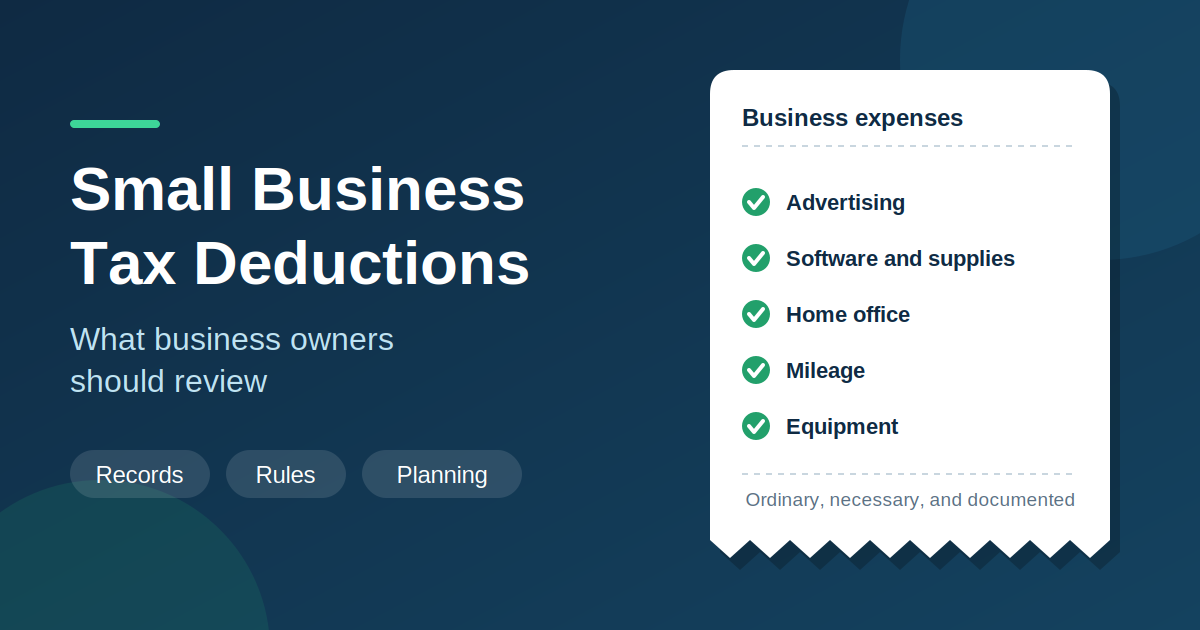
Want a broader list that goes beyond LLCs? Here's our guide to small business tax deductions.
Not sure how this applies to your LLC? You can get help reviewing your business tax plan.
11 Tax Deductions for LLC Owners Worth Knowing
Here's your list of tax deductions for LLC owners.
For each one, I'll give you the basics and the catch.
Rules and limits below are for tax year 2026.
1. Startup and Organizational Costs
Spent money before you opened your doors?
You may be able to deduct up to $5,000 of startup costs in your first year in business.
That $5,000 shrinks dollar for dollar once total startup costs pass $50,000.
It hits zero at $55,000.
Whatever you can't deduct right away gets amortized, which means spread out over 180 months (15 years).
Picture this: you spend $8,000 getting ready to launch.
You may deduct $5,000 in year one and amortize the other $3,000.
Legal costs of setting up the entity can have their own separate $5,000 limit, depending on how your LLC is taxed.
Equipment and vehicles are different.
They're capital assets, so they follow the depreciation rules in #5.
2. Rent and Utilities
Rent for an office, studio, or shop is generally deductible when it's for your business.
So are business utilities.
If the space is shared with personal use, only the business portion counts.
3. Home Office
Working from home?
You need a space used regularly and exclusively for business.
Your kitchen table that doubles as the dinner table usually won't qualify.
You have two ways to calculate it:
• Simplified method: $5 per square foot, up to 300 square feet, for a maximum of $1,500.
• Regular method: your actual home expenses times the business-use percentage, reported on Form 8829 if you file Schedule C.
If your LLC is taxed as an S corporation or partnership, home office rules work differently, so check with a pro.
4. Vehicle and Mileage
You can generally use the standard mileage rate or your actual vehicle expenses.
The IRS set the 2026 business rate at 72.5 cents per mile at the start of the year.
Then it raised the rate to 76 cents per mile starting July 1.
Picture this: Maya runs a two-person design LLC.
In March, she drives 1,000 business miles to client sites.
In September, she drives another 1,000.
March comes to $725, and September comes to $760.
Same distance, different rate.
That's why you need a dated log and not a guess.
Your log should show the date, destination, business purpose, and miles.
If you want the standard mileage rate on a car you own, the IRS says you generally have to choose it in the first year the car is available for business use.
And your commute to a regular workplace doesn't count.
5. Equipment, Computers, and Depreciation
A laptop, a camera, or a work truck usually lasts more than a year.
That makes it a capital expenditure, which normally gets depreciated over time.
Two tools can speed that up:
• Section 179: lets you expense qualifying property in the year you place it in service. The 2026 limit is $2,560,000, and it starts phasing out once purchases pass $4,090,000.
• Bonus depreciation: 100% for qualified property acquired after January 19, 2025, under the One Big Beautiful Bill Act (OBBBA).
Section 179 is also limited by your business taxable income.
Heavy SUVs have a lower Section 179 cap of $32,000 for 2026.
Property with personal use generally needs more than 50% business use to qualify.
You report all of this on Form 4562.
Simple rule of thumb: day-to-day costs get deducted this year, and long-lasting purchases follow depreciation rules.
6. Software, Phone, and Internet
Business software and subscriptions are generally deductible.
Phone and internet bills are deductible for the business-use portion.
If you use your phone 70% for work, don't deduct 100%.
A separate business line makes your life much easier.
7. Marketing and Advertising
Your website, online ads, business cards, and promotional costs are generally deductible.
Business gifts have their own limits, so check before you deduct them.
8. Professional Fees
Accountants, attorneys, and consultants you hire to run your business are generally deductible.
Fees tied to forming the LLC are handled as organizational costs (see #1).
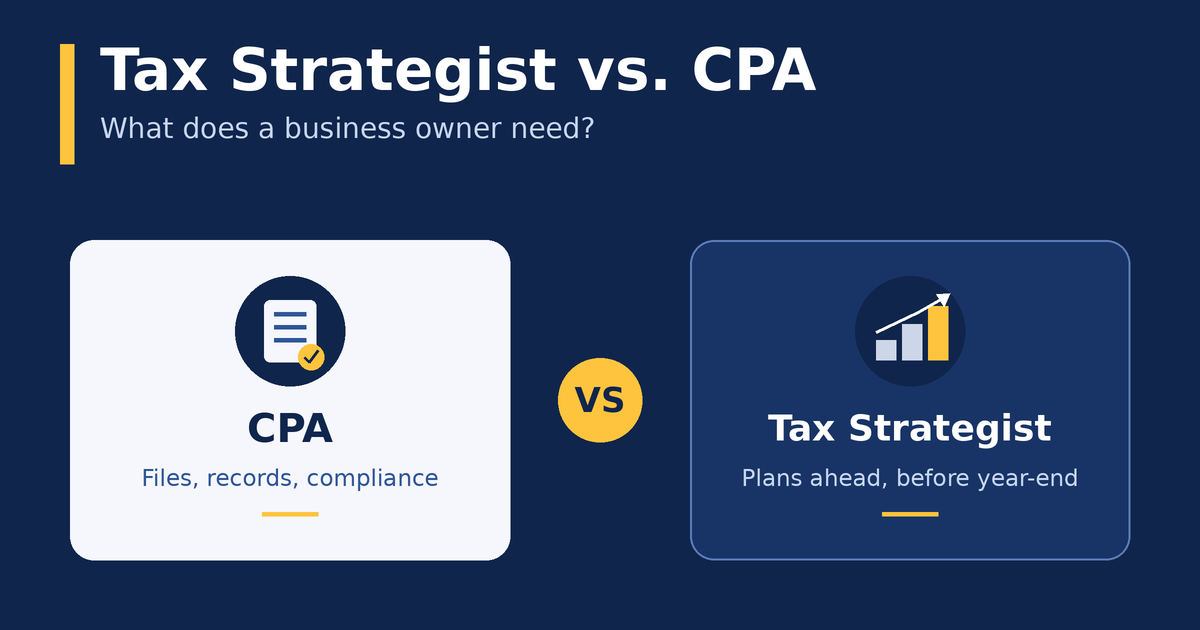
Not sure whether you need a CPA or a strategist? I break that down in tax strategist vs. CPA.
9. Business Insurance
General liability, professional liability, and business property coverage are generally deductible.
Health insurance for you as the owner follows its own rules, so ask your tax pro.
10. Payroll and Contractors
Wages, payroll taxes, and payments to contractors are generally deductible.
Your own owner draws are not wages, so they're not a deduction.
If your LLC is taxed as an S corporation, owner-employee wages work differently.
Paying contractors usually comes with 1099 paperwork, so keep their details on file.
11. Business Meals and Travel
Business meals are generally limited to 50%.
The meal needs a real business purpose, and you should note who was there and why.
Entertainment, like concert tickets for a client, is not deductible.
Travel costs like airfare and lodging can be deductible when you're traveling away from your tax home for business.
Your commute and personal side trips are not.
Want to make sure your list fits your situation? You can get help reviewing your business tax plan.
Expenses That Don't Count as Tax Deductions for LLC Owners

Some expenses never make the cut.
Watch out for these:
• Personal expenses: groceries, personal subscriptions, household bills
• Commuting: getting from home to your regular workplace
• Entertainment: sporting events, concerts, golf outings
• Fines and penalties: speeding tickets, late-filing penalties
• Political contributions
• Childcare and other household costs
• Owner draws: that's you paying yourself, not an expense
Mixed-use expense?
Split it.
Deduct the business part and leave the personal part out.
Unsure whether something counts? You can get help reviewing your business tax plan.
How Your LLC Classification Changes Tax Deductions for LLC Owners
Same expense, different place on the tax return.
Here's how the default setups work:
| LLC type | How it's taxed | Where expenses go |
|---|---|---|
| Single-member LLC (default) | Disregarded entity, taxed like a sole proprietor | Schedule C, filed with Form 1040 |
| Multi-member LLC (default) | Partnership | Form 1065, with a Schedule K-1 for each member |
| LLC that elects S corp status | S corporation | Form 1120-S |
| LLC that elects C corp status | C corporation | Form 1120 |
Most LLCs are pass-through entities.
That means business profit flows to your personal return.
Your deductions reduce that profit before it gets taxed.
Two other items are worth knowing about as an owner:
• Self-employment tax: many LLC owners owe it on net earnings, and you may be able to deduct half of it.
• QBI deduction: many pass-through owners may deduct up to 20% of qualified business income.
The QBI deduction was made permanent by OBBBA, which the IRS also refers to as the Working Families Tax Cuts Act.
For 2026, the full deduction generally applies when taxable income is at or below $201,750 for single filers or $403,500 for married couples filing jointly.
Above those levels, extra limits phase in up to $276,750 and $553,500.
There's also a new $400 minimum deduction if you have at least $1,000 of QBI and materially participate in the business.
QBI isn't an expense you track.
It's a separate deduction on your personal return.
State rules vary too, and some states charge fees or taxes at the LLC level.
Check your state's rules before you file.
Not sure how your LLC is classified? You can get help reviewing your business tax plan.
How to Track LLC Business Expenses So They Hold Up
Tax deductions for LLC owners are only as strong as your records.
Here's the simple system:
• Open a separate business bank account and card. Never mix personal and business spending.
• Save every receipt and invoice. Photos are fine.
• Keep a mileage log with date, destination, purpose, and miles.
• Write the business purpose on meals and travel the same day.
• Categorize expenses monthly. Don't wait until tax time.
Mixing personal and business money is the fastest way to make deductions hard to prove.
It can also blur the line between you and your LLC, which matters for liability protection.
Ask an attorney how that applies to you.
If your records are a mess, you can get help reviewing your business tax plan.
A Year-End Checklist for LLC Tax Write-Offs
Year-end comes faster than you think, and it's a good time to review your tax deductions for LLC owners.
Before December 31, run through this list:
• Review your books and fix miscategorized expenses.
• Reconcile your mileage log, and remember the rate changed on July 1.
• Confirm which equipment will be placed in service by December 31.
• If you use cash-basis accounting, expenses generally count in the year you pay them.
• Gather receipts and invoices for anything missing.
• Talk to a pro before making a big purchase.
One warning.
Don't buy something just for the deduction.
A deduction lowers your taxable income.
It doesn't give you the money back.
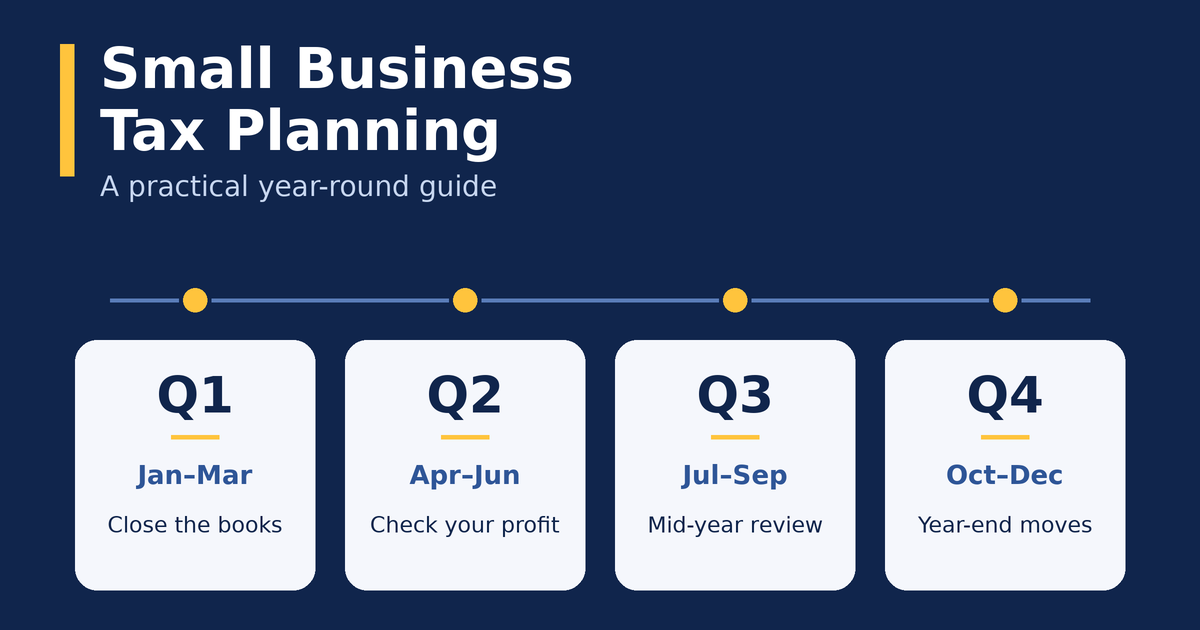
For the bigger picture, read our guide to small business tax planning.
And if you'd like help building a plan, see our tax planning services page or get help reviewing your business tax plan.
Quick Table: Tax Deductions for LLC Owners at a Glance
Skimming?
Here's the cheat sheet for LLC tax write-offs.
| Expense | Usually deductible? | Watch for |
|---|---|---|
| Software subscription | Yes | Business-use percentage if mixed |
| Client lunch | Yes, generally 50% | Business purpose and who attended |
| Business laptop | Yes, through depreciation or Section 179 | Placed-in-service date, business use |
| Home office | Yes, if regular and exclusive use | Simplified vs. regular method |
| Business mileage | Yes | Dated log, correct rate for the date |
| Business insurance | Yes | Owner health insurance has its own rules |
| Concert tickets for a client | No | Entertainment is not deductible |
| Commute to your regular workplace | No | Personal travel |
| Speeding ticket | No | Fines and penalties |
| Personal groceries | No | Personal expense |
Want this cheat sheet matched to your own expenses? You can get help reviewing your business tax plan.
FAQ: Tax Deductions for an LLC
What expenses can an LLC write off?
Generally, any ordinary and necessary business expense, like rent, software, marketing, insurance, professional fees, and wages. Personal expenses don't qualify.
Are LLC meals 100% deductible?
Usually not. Business meals are generally limited to 50%, and entertainment isn't deductible.
Can I write off my car payment as an LLC?
Not as a simple line item. You generally choose between the standard mileage rate and actual vehicle expenses, and only the business-use portion counts.
Can I deduct my cell phone bill?
Yes, for the business-use portion. Keep a reasonable record of how you split work and personal use.
How much can an LLC deduct in startup costs?
Up to $5,000 in the first year, reduced dollar for dollar once startup costs pass $50,000. The rest is amortized over 180 months.
Can I deduct expenses I paid before forming my LLC?
Some of them may count as startup costs, deducted or amortized once the business begins operating. Keep receipts from before you opened.
What if I don't have receipts?
Records are your proof, so missing ones make a deduction harder to defend. Bank statements and emails can help you rebuild a trail, and a tax pro can tell you what's reasonable for your situation.
Do single-member and multi-member LLCs deduct differently?
The expenses are mostly the same. The difference is where they're reported: Schedule C for a default single-member LLC, and Form 1065 for a default multi-member LLC.
Is the QBI deduction an LLC expense?
No. It's a separate deduction on your personal return, and eligibility depends on your income and business type.
Still have questions about your situation? You can get help reviewing your business tax plan.
The Bottom Line on LLC Tax Write-Offs
Three things matter most: your classification, your expenses, and your records.
Get those right, and you'll have a much clearer picture of what you can claim.
Rules and limits change, so confirm current numbers on IRS.gov or with a tax professional before you file.
If you want help pulling it together, you can get help reviewing your business tax plan.
Get those three pieces in place, and tax deductions for LLC owners get a lot less scary.







Comments
Leave a Comment
Your email address will not be published. Required fields are marked *