Tax Planning Consultants: Services, Expertise, and Selection Tips
A tax planning consultant sounds like the answer to a lot of tax stress.
But hiring the wrong one can cost you.
You search, and every page sounds the same.
What does a tax planning consultant actually do?
Is this a CPA, or something else?
How do I know if one is any good?
I hear these questions from US business owners all the time.
And they're fair.
The IRS won't slow down because you're busy.
Missed deadlines and missed deductions still cost real money.
In this guide, you'll learn:
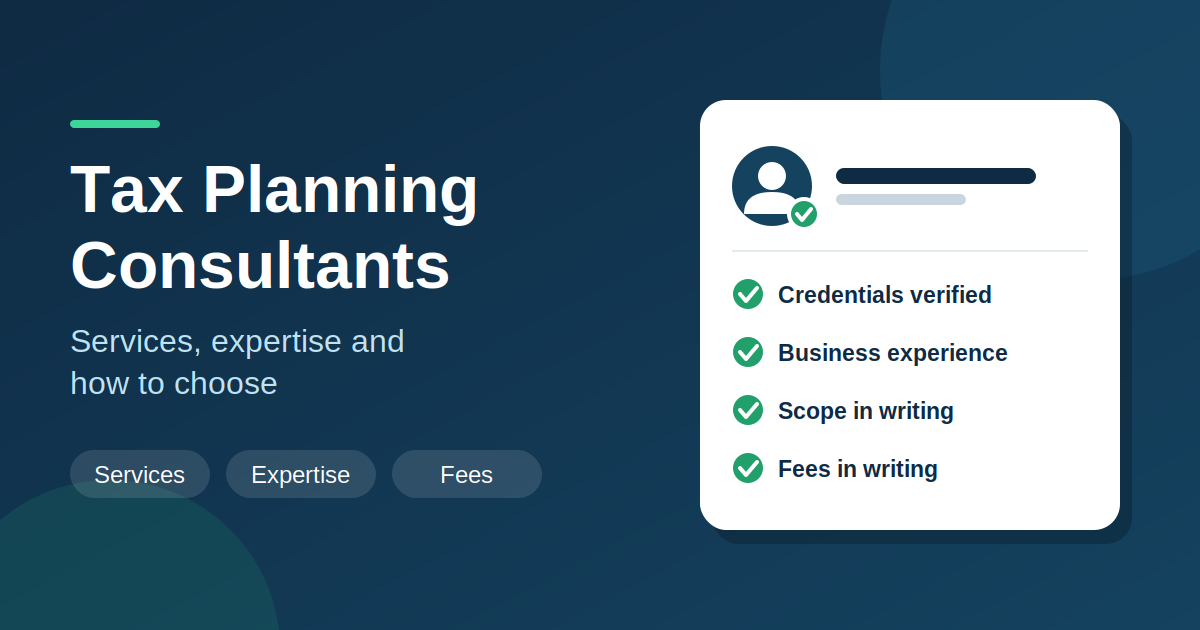
• What a tax planning consultant does, and what falls outside the job
• Which qualifications matter
• What business experience to look for
• What it costs
• What to ask before you sign, and how to tell if it's a fit
Want a simple place to start?
You can explore tax planning support first.
This link is an affiliate link. If you sign up, we may earn a commission at no extra cost to you.
What Does a Tax Planning Consultant Do?
A tax planning consultant helps you pay less tax, legally.
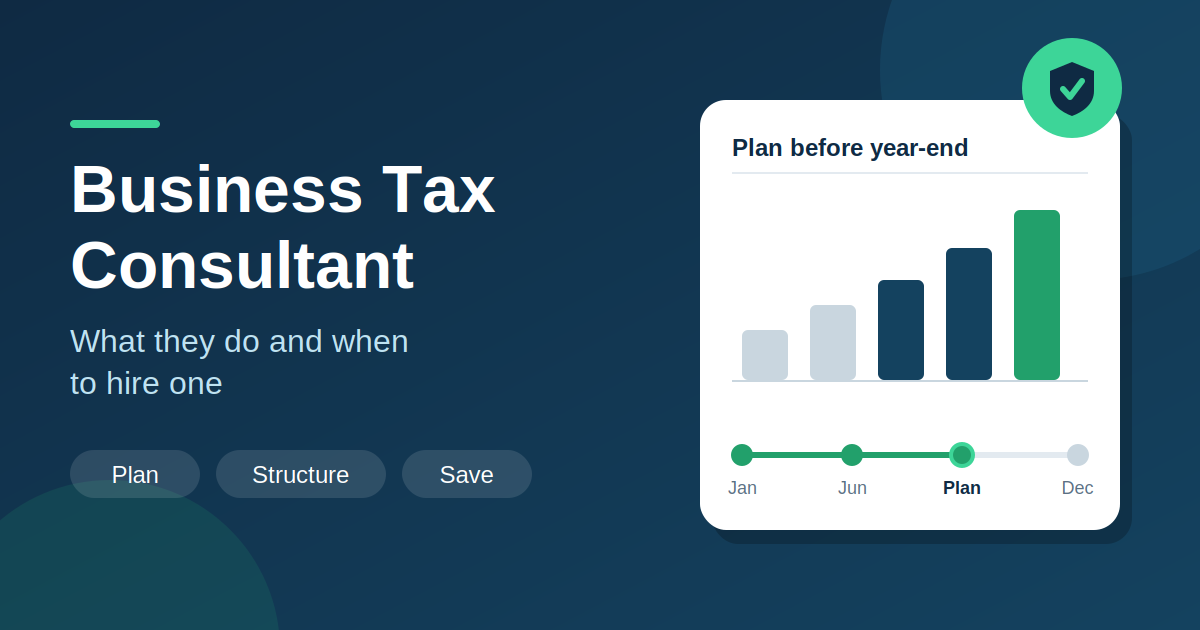
They do it by looking at your numbers before the year ends.
Here's what that looks like.
Planning, not just filing
Filing tells the IRS what already happened.
Planning shapes what happens next.
A good tax planning consultant works with you during the year.
They look at your income, your expenses, and your plans.
Then they point out moves you can still make.
By April, most of those moves are gone.
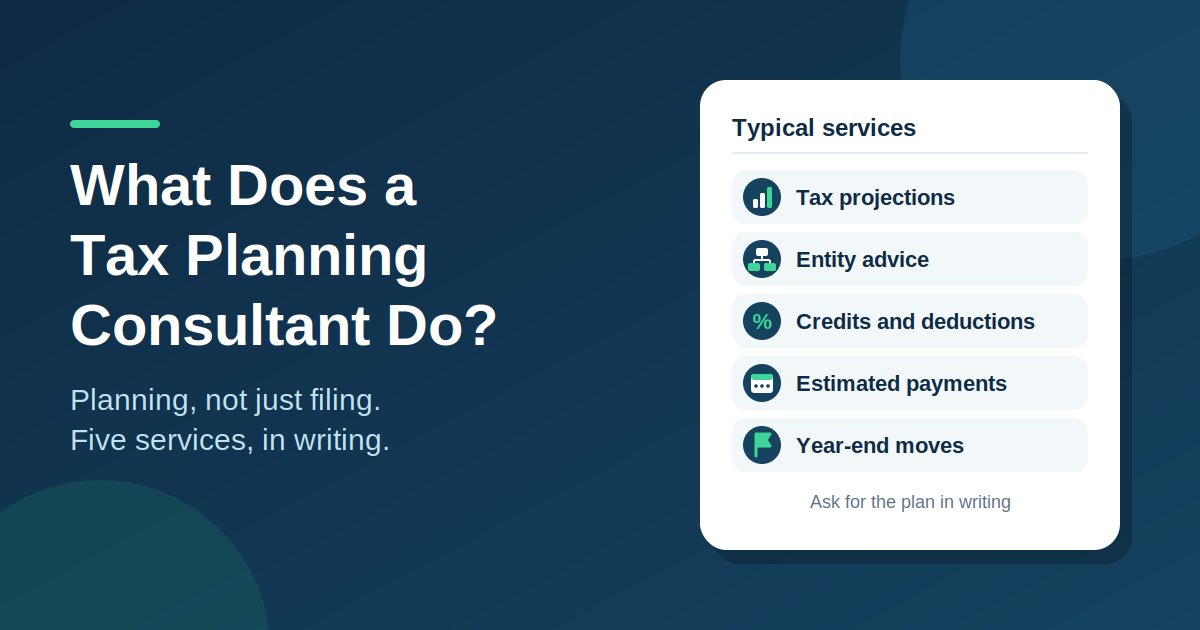
Typical services
Most consultants offer some mix of these:
• Tax projections: An estimate of what you'll owe before the year ends
• Entity advice: Whether an LLC, S corp, or C corp fits your business
• Credits and deductions: Finding the ones that apply to you
• Estimated payments: Setting your quarterly IRS payments so you avoid penalties
• Year-end moves: Timing purchases, income, and retirement contributions
Not every tax planning consultant covers all five.
Ask which ones are included.
What you should get in writing
Good planning leaves a paper trail.
You should walk away with:
• A written plan that explains each strategy and why
• A timeline with dates and action steps
• Updated projections as your income changes
If a tax planning consultant keeps it all verbal, you can't check the work later.
Ask for it in writing.
Tax Planning Consultant Scope: What's Included and What's Not
Before you hire a tax planning consultant, know where the job starts and stops.
Mixed-up expectations are the number one cause of frustration.
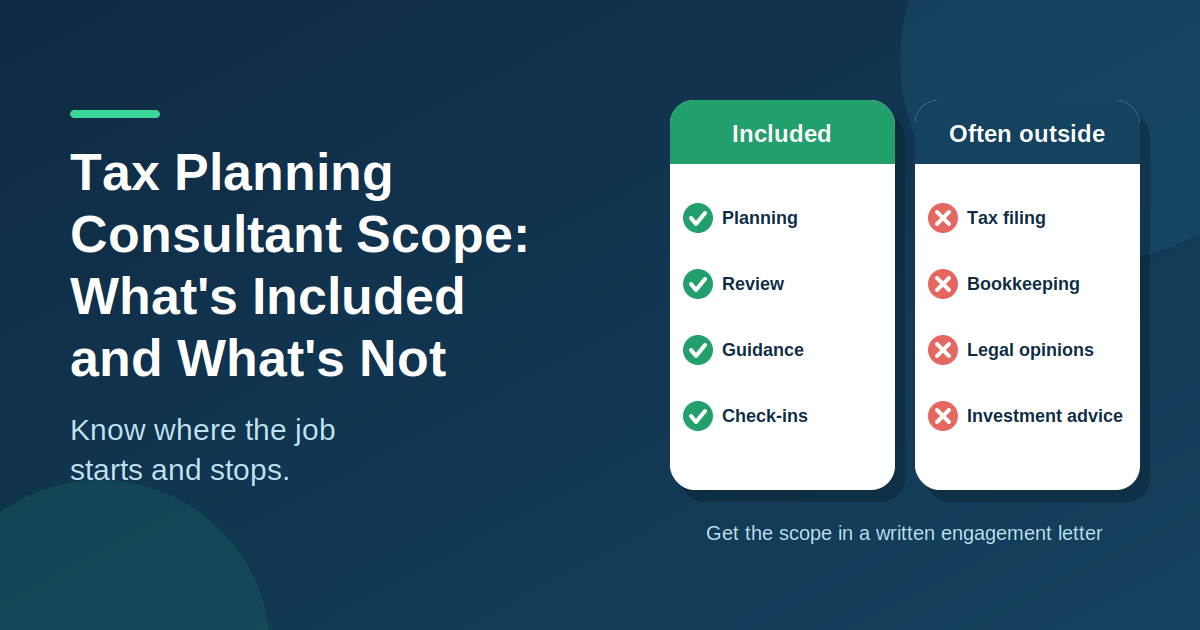
What a consultant usually covers
• Planning: Projections, entity advice, and year-end moves
• Review: Looking at your income, expenses, and past returns
• Guidance: Explaining your options so you can decide
• Check-ins: Updating the plan as your business changes
For a closer look at what planning involves, see these tax planning services.
What often falls outside
• Tax filing: Many consultants don't prepare your return. Some do. Ask.
• Bookkeeping: Keeping your books clean is usually a separate job.
• Legal opinions: Only a tax attorney can give legal advice.
• Investment advice: That's for a licensed financial advisor.
None of these are bad.
They're just different jobs.
Why scope matters
If the scope is vague, you may assume your consultant is handling something they're not.
That's how a deadline gets missed.
A good tax planning consultant puts the scope in a written engagement letter.
It should say what's included, what's extra, and who files your return.
If it's not in writing, ask for it before you sign.
Qualifications to Look for in a Tax Planning Consultant
The title "tax planning consultant" isn't a license.
Anyone can use it.
So look at the credentials behind the title.
CPA, EA or tax attorney
Three types of pros can represent you before the IRS:
• CPA (Certified Public Accountant): A licensed accountant who can handle planning, accounting, and taxes.
• EA (Enrolled Agent): A tax specialist licensed by the IRS.
• Tax attorney: A lawyer who focuses on tax law.
A good tax planning consultant usually holds one of these.
Ask which one, and for how long.
PTIN and other basics
Anyone who prepares returns for pay needs a PTIN from the IRS.
Any tax planning consultant who files returns should give you theirs.
Also ask about:
• Years in practice
• Continuing education in tax law
• Professional liability insurance
How to verify credentials
Don't just take their word for it.
Check:
• The IRS directory of preparers: Look up a preparer's status and credentials.
• Your state board of accountancy: Confirms a CPA license. The CPA Verify tool can help.
• Your state bar association: Confirms an attorney's license.
It takes about five minutes.
It can save you a lot of trouble.
Credentials aren't everything
A license shows someone passed the test.
Experience shows they can do the work.
You want both.
A tax planning consultant with real credentials will be glad you checked.
Business Experience That Matters in a Tax Planning Consultant
A license shows someone knows tax law.
Experience shows they know businesses like yours.
Here's what to look for in a tax planning consultant.
Your entity type
Taxes work differently for each setup.
• Sole proprietor or single-member LLC: Self-employment tax and quarterly payments
• S corp: Salary, distributions, and payroll
• Partnership or multi-member LLC: Splitting income and K-1s
Ask how many clients they have with your setup.
Your industry
Every industry has its own quirks.
A contractor, a restaurant, and an online seller deal with very different expenses.
A tax planning consultant who knows your industry spots deductions and risks faster.
Your states
More states usually means more tax rules.
That includes income tax, sales tax, and payroll.
If you work in more than one state, ask how they handle it.
Ask for proof of experience
Don't settle for "yes, I've done that."
Ask:
• How many clients like me do you have?
• What kinds of plans have you built for them?
• Can I speak with a client in a similar situation?
A good tax planning consultant will answer without hesitating.
Independent Tax Planning Consultant or Tax Planning Company?
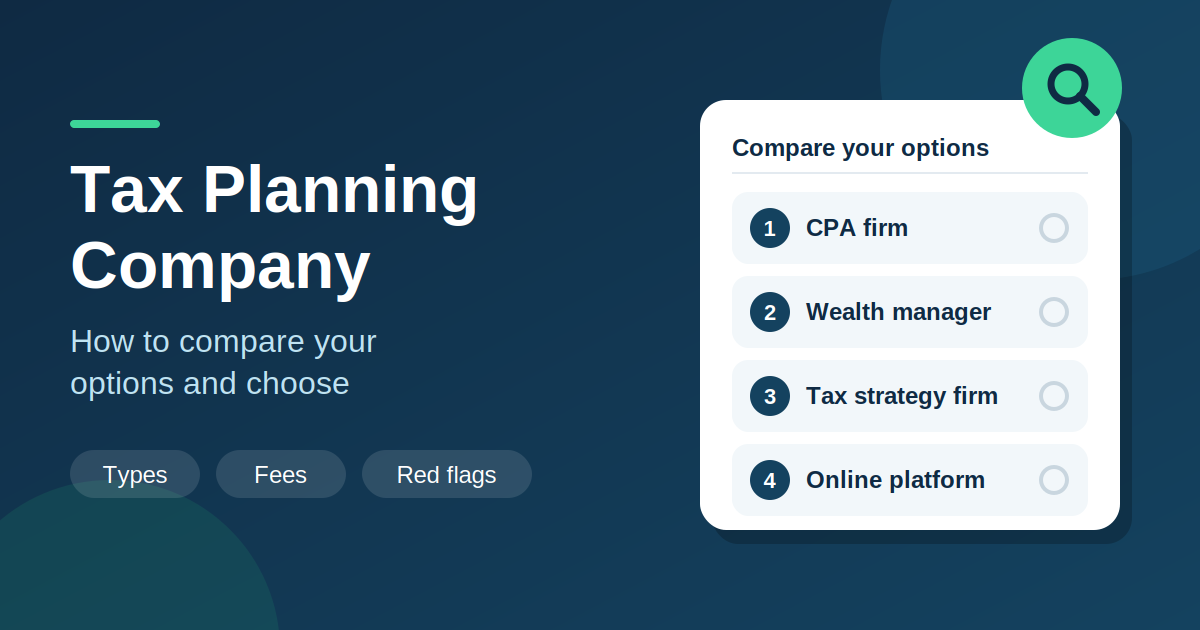
You can get tax planning help from three places.
Each has trade-offs.
An independent consultant
One person, one point of contact.
You usually get personal attention and a direct line.
The trade-off: availability.
If they're out or at capacity, there's no backup.
Best for: Owners who want a long-term working relationship with one person.
A firm
A team handles your planning, often with CPAs, EAs, and support staff.
You get more bench strength.
The trade-off: you may deal with different people over time.
For a deeper look at this option, see this guide to choosing a tax planning company.
Best for: Businesses that want broader services under one roof.
An online platform
These use software to review your numbers, often with professional review on top.
They're usually easier to start with.
HeyDrew is one example.
It's an AI-assisted tax-planning platform for small and mid-sized businesses.
They say tax professionals review the work.
It can sit alongside your CPA, not replace them.
You can see how HeyDrew's tax-planning support works and decide if it fits.
Best for: Owners who want a lower-friction way to start.
How a Tax Planning Consultant Works: From First Call to Ongoing Reviews
Every tax planning consultant works a little differently.
But the process usually looks like this.
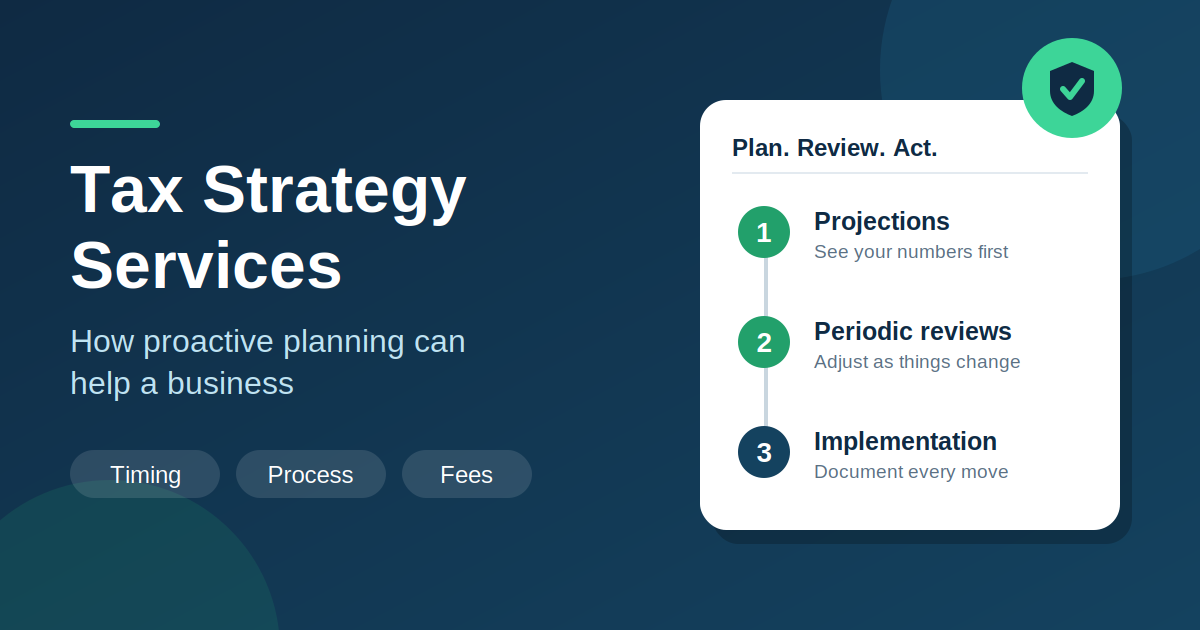
Discovery and projections
It starts with a conversation.
Your tax planning consultant asks about your business, your income, and your goals.
They look at your past returns and your current numbers.
Then they build a projection of what you may owe this year.
This is the core of tax planning consulting.
You see your options before you decide.
The written plan
Next comes the plan.
A good tax planning consultant puts it in writing.
It should explain each move, the reason behind it, and the deadline.
For more on how strategies fit together, see these tax strategy services.
Reviews and implementation
A plan only works if someone carries it out.
Your tax planning consultant should check in during the year and update the numbers.
Ongoing tax-planning support can also come from a platform.
HeyDrew is one example, and they say tax professionals review the work.
It can sit alongside your CPA or consultant, not replace them.
You can see how HeyDrew handles ongoing planning and decide if it fits.
Tax Planning Consultant Fees: What to Expect
Let's talk money.
What a tax planning consultant costs depends on how they charge and how much help you want.
The ranges below come from published US pricing guides.
Treat them as rough guides, not quotes.
Common pricing models
• Hourly: CPAs about $150 to $500, enrolled agents about $150 to $400, and tax attorneys about $220 to $600 or more, according to Harness
• Flat fee: About $1,000 to $5,000 or more for a business tax return, per Harness
• Annual retainer: About $1,500 to $10,000 or more per year for ongoing planning, per Harness
• Monthly retainer: About $500 to $2,000 per month for small businesses, according to Beancount
Those ranges overlap because the scope is different.
Filing alone costs less than planning all year.
What pushes the price up or down
• How complex your business is. More owners, entities, or income streams cost more.
• How many states you file in. Each extra state adds work.
• How clean your books are. Messy records mean more hours.
• How much support you want. Regular reviews and written plans cost more than a one-time check.
• Who does the work. A CPA or attorney usually charges more than a preparer.
Want a deeper look at pricing?
Here's a breakdown of tax strategist cost.
Is a tax planning consultant worth it?
No tax planning consultant can promise savings before seeing your numbers.
Results vary by business and by year.
Ask any tax planning consultant for a written fee and an engagement letter.
Then you know exactly what you're paying for.
Another option to price out
HeyDrew doesn't list its pricing publicly.
You can take their assessment to see how their tax-planning support works and what it might cost for your business.
Questions to Ask Before You Sign With a Tax Planning Consultant
A first call is your chance to size someone up.
Don't waste it on small talk.
Ask these seven questions instead.
I've bolded what you want to hear.
1. Are you a CPA, EA, or attorney?
"Yes, and here's my license number."
2. Do you work with businesses like mine?
"Yes, I have clients with my entity type, in my industry and states."
3. What does your scope include, and what doesn't it?
"Here's the written scope, including who files the return."
4. What will I get in writing?
"A written plan, a timeline, and updated projections."
5. How often will we talk?
"Regular check-ins during the year, not just in April."
6. How do you charge, and what costs extra?
"Here's the fee in writing, and here's what's included."
7. Can I speak with a client like me?
"Yes, I'll connect you."
Listen for clear, specific answers.
Vague answers are a warning sign.
Any tax planning consultant worth hiring will answer all seven without a fuss.
Is This Tax Planning Consultant the Right Fit? Green Flags and Red Flags
You've asked the questions.
Now weigh the answers.
Here's a quick way to tell if a tax planning consultant is a fit.
Green flags
• They show credentials. CPA, EA, or attorney, with a license you can check.
• They ask about your business. Entity, industry, states, and goals.
• They put everything in writing. Scope, plan, and fees.
• They explain things simply. You understand what they're recommending.
• They plan with you year-round. Not just at tax time.
Red flags
• They guarantee savings or a big refund. Nobody can promise that before seeing your numbers.
• They won't show credentials. A real tax planning consultant will gladly share a license.
• They won't sign your return. Paid preparers must sign and include their PTIN.
• They pressure you to sign fast. Good advice can wait a day.
• They vanish after April. You can't plan with someone you can't reach.
If you see more red flags than green, keep looking.
Plenty of other options exist.
A good tax planning consultant makes you feel informed, not rushed.
Want a Simple Way to Start Before You Hire a Tax Planning Consultant?
Not ready to book a call yet?
That's fine.
HeyDrew is an AI-assisted tax-planning platform for small and mid-sized businesses.
They say tax professionals review the work.
Pricing isn't listed publicly, and results vary by business.
It can sit alongside your CPA or tax planning consultant, not replace them.
You can start with a short assessment.
No pressure.
Explore tax planning support from HeyDrew
Disclosure: This link is an affiliate link. If you sign up, we may earn a commission at no extra cost to you.
Tax Planning Consultant FAQs
What does a tax planning consultant do?
A tax planning consultant looks at your income, expenses, and goals during the year.
Then they suggest moves to lower your tax bill and keep you compliant.
That can include projections, entity advice, and year-end planning.
How much does a tax planning consultant cost?
It depends on how they charge.
CPAs often charge about $150 to $500 an hour.
Annual retainers for ongoing planning run about $1,500 to $10,000 or more.
Is a tax planning consultant the same as a CPA?
Not exactly.
"Tax planning consultant" is a job description, not a license.
Many are CPAs or enrolled agents, so check credentials first.
When should I hire a tax planning consultant?
Hire one before a big decision.
That could be growing profit, hiring, adding owners, working in more states, or selling.
Don't wait until April.
What does a tax consultant for tax planning not do?
Many don't file your return, keep your books, give legal opinions, or give investment advice.
Some do, so ask.
Get the scope in a written engagement letter.
Is there a simpler way to start with tax planning support?
Yes.
You can start with a planning platform like HeyDrew, an AI-assisted service for small and mid-sized businesses.
They say tax professionals review the work.
You can explore tax planning support to see how it works.
Final Takeaway
Taxes get easier when you plan ahead.
Know what a consultant does and what falls outside the job.
Check credentials and business experience.
Get the scope and the fees in writing.
Watch for red flags.
Do that, and you'll have real planning, not just paperwork.
Take your time and pick the right tax planning consultant.





Comments
Leave a Comment
Your email address will not be published. Required fields are marked *