Business Tax Consultants: What They Do and When to Hire One
A business tax consultant sounds like something only big companies need.
But the worries hit small owners too.
Is my accountant enough?
Am I paying more tax than I should?
Do I actually need a consultant?
I hear these questions all the time.
And they're fair.
Your accountant keeps the books.
Your preparer files the return.
But who plans your taxes before the year ends?
That's the job of a business tax consultant.
In this guide, you'll learn:
• What a business tax consultant does
• How they differ from a tax preparer and an accountant
• When to hire one
• How to pick the right one
Want a simpler place to start?
You can explore HeyDrew's tax-planning assessment first.
This link is an affiliate link. If you sign up, we may earn a commission at no extra cost to you.
What Does a Business Tax Consultant Do?
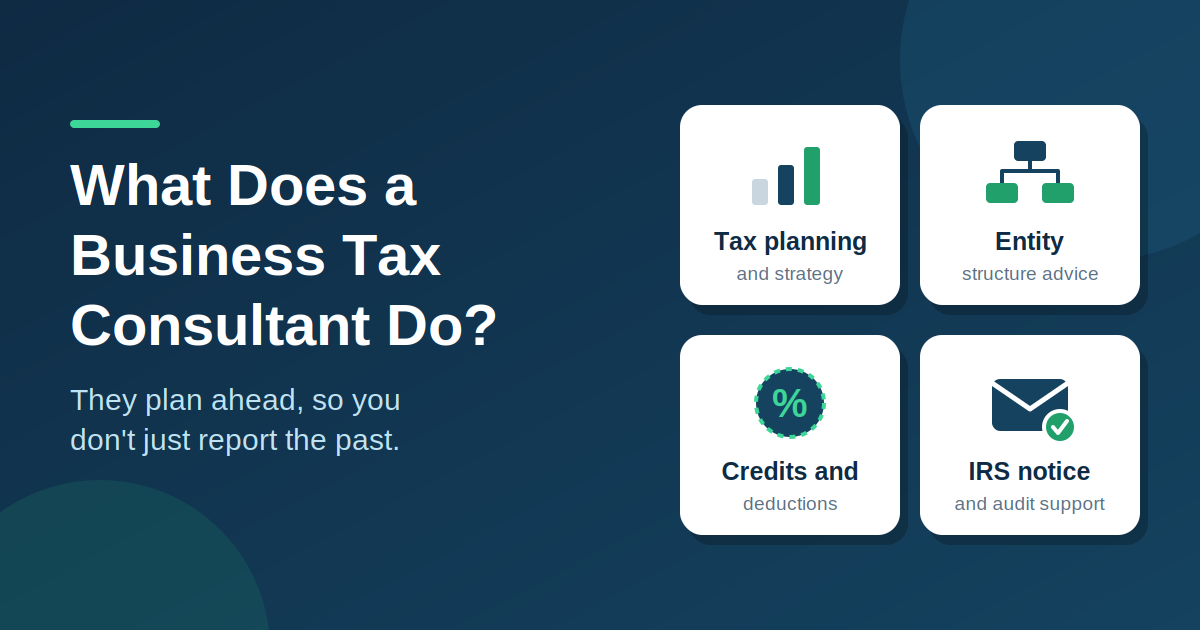
A business tax consultant looks ahead.
Your preparer looks back at last year.
Your consultant helps you shape next year.
Here's what that looks like day to day.
Tax planning and strategy
This is the core of the job.
A business tax consultant looks at your income, expenses, and big plans.
Then they map out moves to make before the year ends.
That might mean timing a purchase.
It might mean changing how you pay yourself.
The goal is simple.
Pay what you owe, and not a dollar more.
Entity structure advice
Your business structure affects your tax bill.
A good consultant can compare:
• Sole proprietorship or LLC
• S corp
• C corp
They'll show you what each one means for your taxes.
They'll also tell you when it's time to switch.
Credits, deductions and estimated payments
Many owners miss savings simply because nobody told them.
A business tax consultant helps you:
• Find credits and deductions that fit your business
• Project your tax during the year
• Set quarterly estimated payments so you avoid underpayment penalties
That last one matters.
Overpay, and you tie up cash.
Underpay, and you get hit with penalties.
Audit and IRS notice support
Nobody likes opening a letter from the IRS.
Many consultants help you respond to notices and handle audits.
Just check their credentials first.
Only CPAs, enrolled agents, and tax attorneys can represent you before the IRS.
Not sure about the title?
A business tax advisor often does much of the same work.
Always check credentials, not job titles.
Business Tax Consulting Services to Look For
Not every consultant offers the same menu.
Some stick to the basics.
Others go deep on one niche.
Here's what to look for in business tax consulting services.
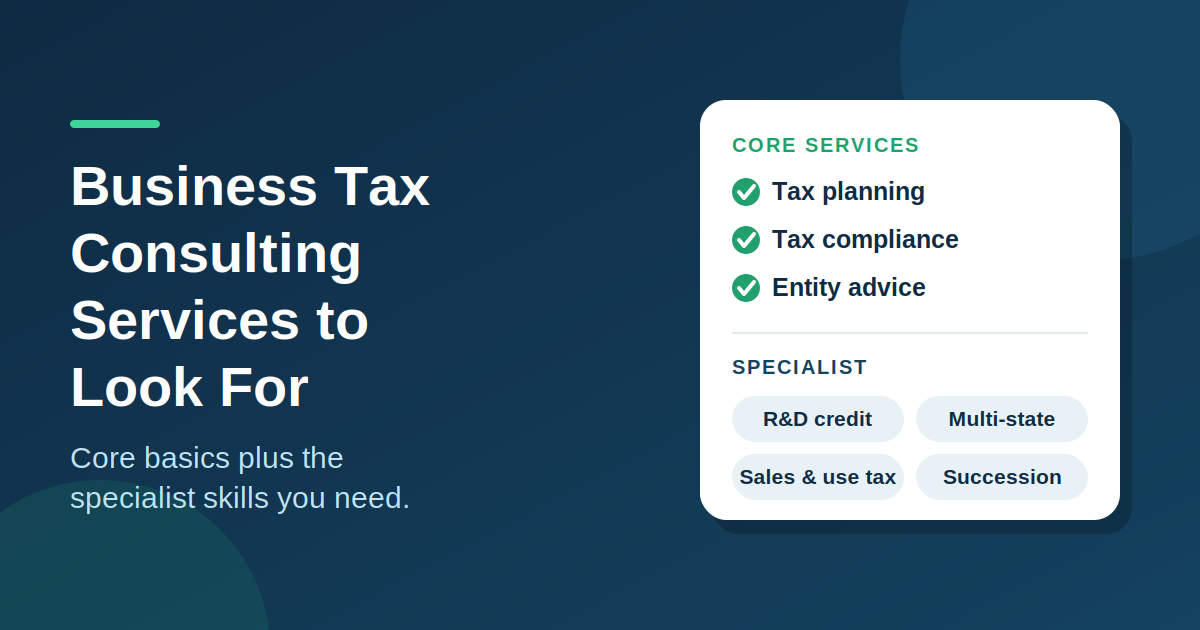
Core services
Every good business tax consultant should cover these:
• Tax planning: Moves you make before year-end to lower your bill
• Tax compliance: Filing the right returns, on time
• Entity advice: Picking and reviewing your LLC, S corp, or C corp setup
If a consultant can't do these, keep looking.
Specialist services
Some businesses need more than the basics.
Ask about these if they apply to you:
• R&D tax credit: For companies that build, design, or improve products
• Multi-state tax and nexus: For businesses that sell or work in more than one state
• Sales and use tax: For businesses that collect and report it
• Succession planning: For owners who want to sell or pass on the business
Not every business tax consultant handles these well.
Ask for proof of experience.
Match the service to your situation
• Just need a smarter filing? Look for planning plus compliance.
• Thinking about an S corp? Look for entity advice.
• Building a product? Look for R&D credit experience.
• Selling across state lines? Look for nexus and sales tax skills.
• Planning an exit? Look for succession experience.
A simpler starting point
Not ready to hire someone yet?
Some owners start with a planning platform instead.
HeyDrew is one example.
It's an AI-assisted tax-planning platform for small and mid-sized businesses.
They say tax professionals review the work, and it can sit alongside your CPA or consultant.
You can see how HeyDrew's year-round planning works and decide if it fits.
Business Tax Consultant vs. Tax Preparer vs. Accountant
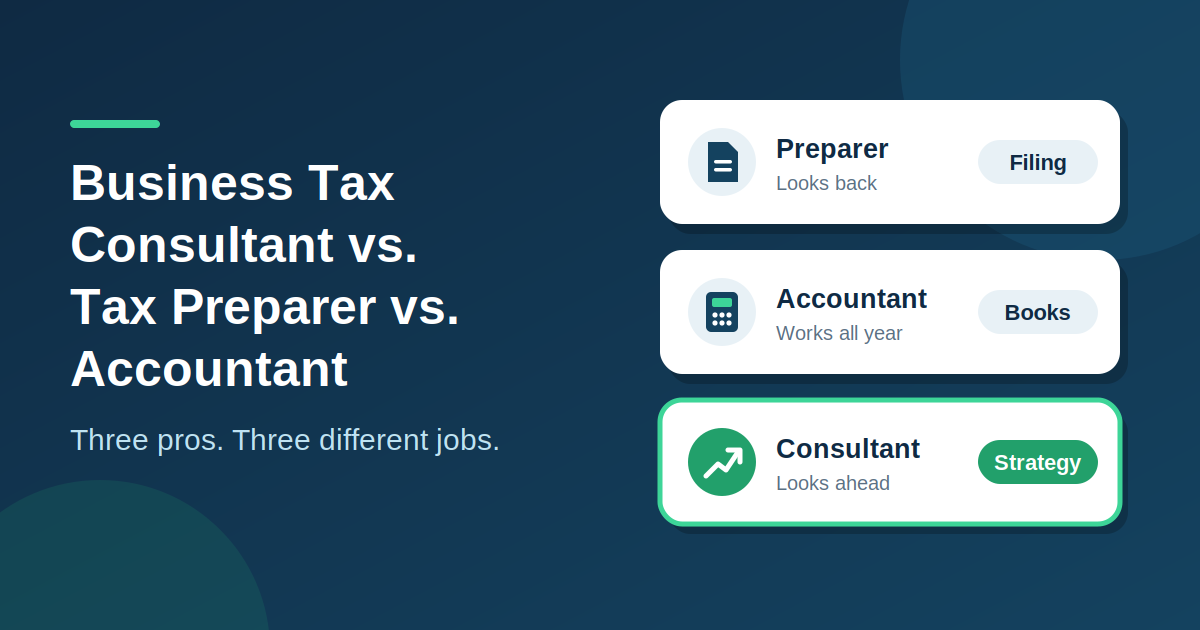
These three get mixed up all the time.
They overlap a little.
But they do different jobs.
The quick breakdown
• Tax preparer: Fills out and files your return. Looks at what already happened.
• Accountant: Keeps your books, tracks income and expenses, and builds your financial statements.
• Business tax consultant: Plans your taxes ahead of time. Looks at what you can change.
Here's another way to see it.
• Preparer = filing
• Accountant = books
• Consultant = strategy
Timing matters
A preparer usually shows up once a year.
An accountant works through the year.
A business tax consultant works before decisions get made.
That's where the savings come from.
Where CPAs, EAs and tax attorneys fit
These are credentials, not job titles:
• CPA: A licensed accountant who can do books, taxes, and planning.
• Enrolled agent (EA): A tax specialist licensed by the IRS.
• Tax attorney: A lawyer who focuses on tax law.
All three can represent you before the IRS.
A regular preparer with only a PTIN can't fully do that.
Many consultants are CPAs or EAs.
The title "business tax consultant" isn't a license, so always check credentials.
Do you need all three?
Not always.
Many small businesses use a CPA for the first two jobs and add planning as they grow.
Want to see how a strategist compares with a CPA?
Here's a breakdown of tax strategist vs. CPA.
When to Hire a Business Tax Consultant
Timing matters more than most owners think.
The best tax decisions get made before the deadline.
Not after.
So when does it make sense to bring someone in?
Signs it's time to hire a business tax consultant
If any of these sound like you, it's worth a call:
• Your profit is growing. More income means more tax, and more ways to plan.
• You're hiring. Payroll adds rules, deadlines, and costs.
• You have more than one owner. Splitting income and decisions gets tricky.
• You work in more than one state. Each state may have its own rules.
• You're making a big purchase. Timing can change your deduction.
• You're selling or restructuring. One wrong move can cost you a lot.
• You got an IRS notice. Don't guess. Get help.
Most of these share one thing.
A big decision is coming.
That's the moment a business tax consultant earns their fee.
When you probably don't need one yet
You may be fine without a consultant if:
• You're just starting out
• Your income is low and steady
• You're a sole proprietor with simple expenses
In that case, a good preparer and clean books may be enough.
If you're earlier in your journey, a small business tax advisor can be a better fit.
They focus on owners who need solid basics and clear advice.
A simple rule
Ask yourself this.
Is a decision coming that could change my tax bill?
If yes, talk to a business tax consultant first.
If no, keep your setup simple for now.
One-Time Help vs. Ongoing Tax Strategy
There are two ways to work with a consultant.
You can hire help for one project.
Or you can plan all year long.
One-time help
This is project-based work.
You bring in a business tax consultant for a single job.
Common examples:
• Choosing an entity before you launch or switch
• Reviewing a big purchase before you buy
• Handling an IRS notice or audit
It's focused and it ends when the project does.
That works well when you know exactly what you need.
Ongoing tax strategy
This is year-round planning.
You check in during the year, not just before the deadline.
A business tax consultant on an ongoing plan can:
• Project your tax as the year moves along
• Adjust your payments when income changes
• Flag moves to make before December 31
Why does this beat filing after the year ends?
Because by April, most of the decisions are already made.
Planning lets you act while you still can.
Where a platform fits in
Some owners add a planning platform on top of their CPA or consultant.
HeyDrew is one option.
It's an AI-assisted tax-planning platform for small and mid-sized businesses.
They say tax professionals review the work.
It's built to sit alongside your CPA or consultant, not replace them.
You can take the HeyDrew assessment to see how their planning process works.
How to Evaluate a Business Tax Consultant
Anyone can call themselves a business tax consultant.
So you need a way to tell the good ones from the rest.
Use this checklist.
I've bolded what you want to hear.
The evaluation checklist
• Credentials: Are you a CPA, EA, or attorney?
"Yes, and here's my license number."
• Industry experience: Do you work with businesses like mine?
"Yes, and here's the kind of work I've done."
• Planning vs. paperwork: Will you plan with me during the year?
"Yes, we'll check in before big decisions."
• Communication: How fast do you reply?
"Within one or two business days."
• Written scope: What exactly is included?
"It's all in a written engagement letter."
• Fee clarity: How do you charge?
"Flat fee, hourly, or retainer, in writing."
• References: Can I talk to a client like me?
"Yes, I'll connect you."
A good business tax consultant answers these without a fuss.
Red flags to walk away from
• They guarantee savings. Nobody can promise that before seeing your numbers.
• They won't sign your return. Paid preparers must sign and include their PTIN.
• They push aggressive tricks. If it sounds too good to be true, it usually is.
• They disappear after April. You can't plan with someone you can't reach.
If you spot even one, move on.
Plenty of other options exist.
Before you hire, you can verify a preparer through the IRS directory of preparers.
Then trust your gut on the rest.
Business Tax Consultant Fees: What to Expect
Let's talk money.
What a business tax consultant costs depends on who you hire and what you need.
The numbers below are rough ranges from published pricing guides.
Your quote may land higher or lower.
Typical price ranges
• CPAs and enrolled agents: About $150 to $400 per hour, according to ConsultFees
• Tax attorneys: About $200 to $550 per hour, per the same guide
• Business tax returns: About $750 to $2,500 or more
• Custom yearly plans: About $1,300 to $2,000 or more, depending on the source (Bench and Finance Strategists both land in this range)
Hourly works for one-off questions.
A flat fee works for a defined project.
A yearly plan works if you want help all year.
What pushes the price up or down
• How complex your business is. Multiple owners or states cost more.
• How clean your books are. Messy records mean more hours.
• How much support you want. Filing only costs less than planning all year.
• How specialized the work is. R&D credits and multi-state reviews often cost more.
• Who you hire. Experienced pros charge more, and may save you more.
Want a deeper look at pricing?
Here's a breakdown of tax strategist cost.
Cheap isn't always cheap
A low fee can cost you if deductions get missed.
Look at what you get, not only what you pay.
A good business tax consultant can save more than they charge.
No one can promise that upfront, so ask how they've done it for others.
Another option to price out
HeyDrew doesn't list its pricing publicly.
You can take their assessment to see how their planning process works and what it might cost for your business.
Want Proactive Tax Planning Support?
If you'd rather plan during the year than scramble in April, HeyDrew is worth a look.
It's an AI-assisted tax-planning platform for small and mid-sized businesses.
They say tax professionals review the work.
Pricing isn't listed publicly, and results vary by business.
It can sit alongside your CPA or business tax consultant, not replace them.
You can start with a short assessment.
No pressure.
Explore HeyDrew's tax-planning service
Disclosure: This link is an affiliate link. If you sign up, we may earn a commission at no extra cost to you.
Business Tax Consultant FAQs
What does a business tax consultant do?
A business tax consultant plans your taxes ahead of time.
They look at your income, expenses, and structure.
Then they suggest moves to lower your bill and keep you compliant.
How much does a business tax consultant cost?
It depends on who you hire.
CPAs and enrolled agents often charge about $150 to $400 an hour.
Custom yearly plans often run about $1,300 to $2,000 or more.
Is a business tax consultant the same as a CPA?
Not exactly.
"Consultant" is a job description, not a license.
Many consultants are CPAs or enrolled agents, so check credentials first.
When should I hire a business tax consultant?
Hire one before a big decision.
That could be growing profit, hiring, adding owners, working in more states, selling, or getting an IRS notice.
Don't wait until April.
Can a tax consultant for business help with an audit?
Yes, if they're a CPA, EA, or tax attorney.
These pros can represent you before the IRS.
Ask upfront if audit help is included or costs extra.
Is there a simpler way to start with business tax consulting?
Yes.
You can start with a planning platform like HeyDrew, an AI-assisted service for small and mid-sized businesses.
They say tax professionals review the work.
You can take the HeyDrew assessment to see how it works.
Final Takeaway
Taxes get easier when you plan ahead.
Know what a consultant does.
Compare them with your preparer and accountant.
Hire before big decisions, not after.
Check credentials, ask the right questions, and watch for red flags.
Do that, and you'll get real help, not just paperwork.
Take your time and pick the right business tax consultant.







Comments
Leave a Comment
Your email address will not be published. Required fields are marked *